



Seamlessly integrate and manage your energy assets to maximize portfolio returns across all major European markets.
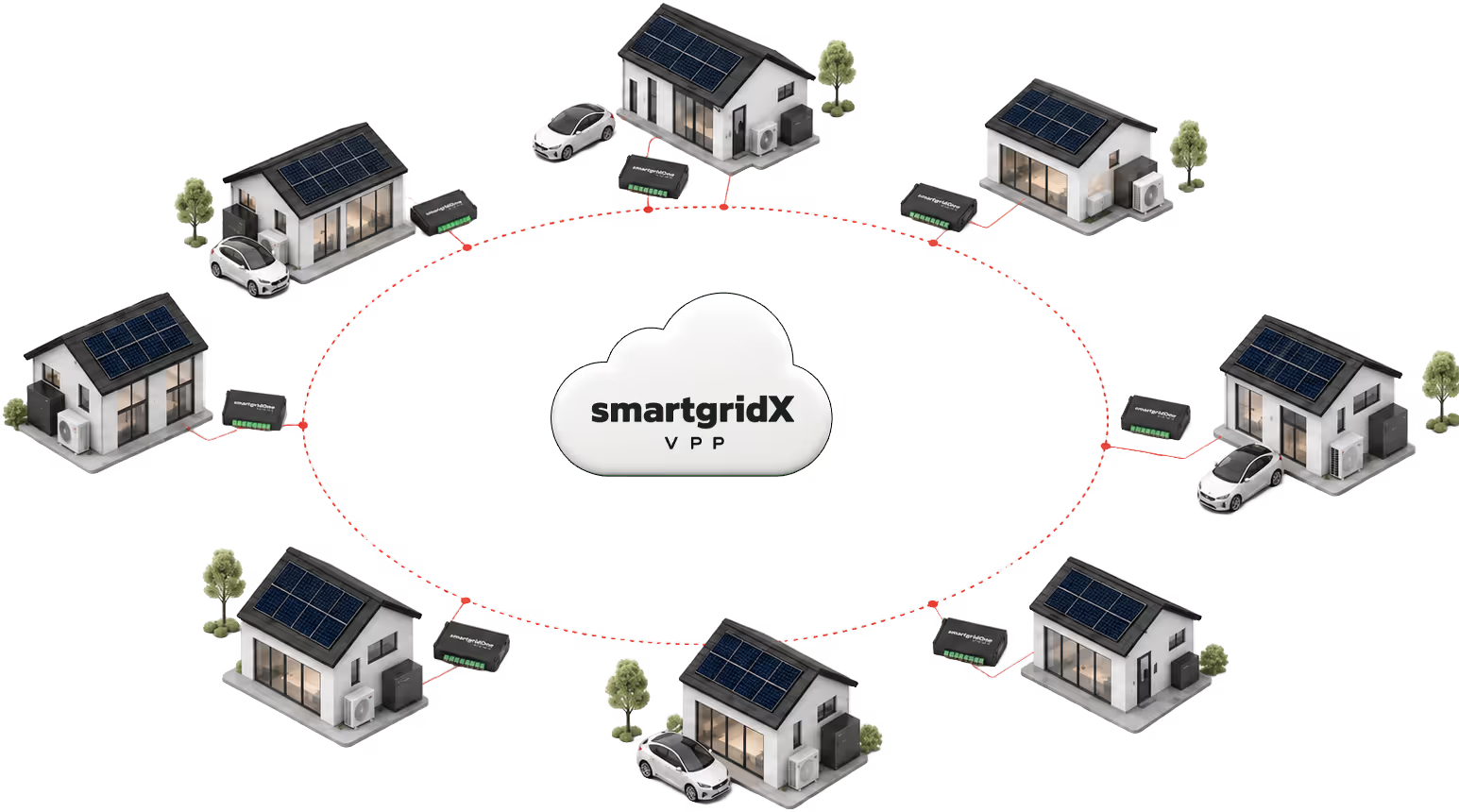
SmartgridX is Eniris’s Virtual Power Plant (VPP). It seamlessly integrates assets equipped with SmartgridOne EMS hardware, third-party EMS systems, and assets controlled via API with the SmartgridOne Cloud. As an energy supplier or trader, you can manage this VPP yourself or partner with Eniris to set up a multi-market strategy. By optimizing across Day-Ahead, Intraday, Imbalance, and Ancillary markets, we help you maximize your overall portfolio returns.


.svg)


The setting of actual (‘hard’) import and export limits for specific time periods or for the current quarter-hour is fully supported via the Eniris MQTT protocol (specifically under ‘Site Control’).
(Internal test phase): Eniris is currently testing a functionality in which limits are not treated as absolute hard peak limits, but are based on quarter-hourly averages. This allows for short-term power peaks in the plant, provided the resulting quarter-hourly average is maintained.
When grid limits are transmitted, the underlying systems respond automatically. The priority and sequence of adjustment depend on the active control mode of the device type. For example, if the system is set to ‘Self-consumption from the battery’, the Eniris system first stores surpluses from PV production locally in the battery before curtailing the solar modules to comply with the grid limit.
Limits temporarily set for trading purposes can be overridden at any time by sending a so-called “fallback” message via MQTT. During this fallback status, the system suspends the control of trading targets and monitors only the customer’s connected load (GTV). This serves as a purely hardware-based safeguard to prevent the fuses from being overloaded.
The functionality for setting a negative import limit (which enforces a minimum export value of X, crucial for congestion management) is not supported by default. However, this specific behaviour can be implemented. Eniris transmits the complete system status (including battery power, battery state of charge, PV yield and consumption) and enables direct control of each individual controllable system via MQTT. Therefore, an external actor can take over control based on the shared data to enforce an export or import.


.svg)
.svg)
.svg)

.svg)

.svg)


